
Oregon
Oregon Democrats spark statewide political backlash after blaming Trump for gas price surge, as Republicans slam claims and accuse them of dodging responsibility amid rising fuel costs
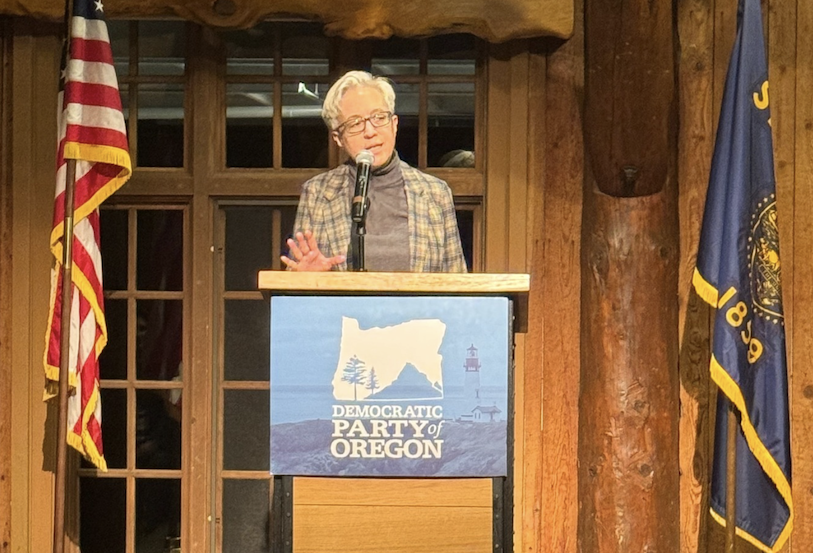
Oregon – A growing political debate in Oregon over rising fuel prices has drawn indirect references to former President Donald Trump’s foreign policy decisions, as Democratic officials and lawmakers point to global instability in the Middle East as a key driver of higher gasoline costs.
The discussion comes amid a broader national surge in fuel prices connected to the ongoing conflict involving Iran, which disrupted global oil supply routes and pushed U.S. gas prices above $4 per gallon in many regions. According to reporting from the Associated Press, Oregon Democrats have argued that the price increases are not solely domestic in origin, but are heavily influenced by international developments tied to the war in Iran and its political roots in earlier U.S. policy decisions, including actions taken during Trump’s presidency.
At the state level, Oregon officials, including Gov. Tina Kotek, have framed the issue as part of a broader affordability challenge facing households. Democrats have defended recent transportation and infrastructure funding measures, including a gas tax increase, arguing that stable road funding is necessary even during periods of economic pressure. However, critics have seized on the timing, saying that higher fuel costs make additional taxes harder to justify.
The political argument intensified as Oregon voters were set to weigh a referendum on whether to repeal the state’s gas tax increase. Republicans quickly gathered enough signatures to place the measure on the ballot, framing it as a direct response to rising household costs. Democrats, meanwhile, have emphasized long-term infrastructure needs while acknowledging that current fuel prices complicate their messaging.
In public statements reported by the Associated Press, Oregon Democrats pointed to the Iran conflict as a major factor behind the spike in gasoline prices. They argued that global energy disruption, including instability in key oil transport routes, has played a significant role in pushing prices higher across the United States. Some Democratic officials tied the origins of the conflict indirectly to earlier U.S. foreign policy decisions under former President Trump, particularly his administration’s approach to Iran and military engagement in the region.
The framing has become politically sensitive, as Republicans reject the idea that foreign policy decisions from previous administrations are responsible for current fuel costs. Instead, they argue that state-level taxation is exacerbating financial strain on consumers. The result has been a layered political dispute in Oregon that blends local tax policy with global geopolitical tensions.
National polling suggests that Americans are deeply divided on responsibility for rising gas prices. A Reuters/Ipsos survey found that a majority of respondents blame President Donald Trump’s handling of the Iran conflict and related economic consequences for increased fuel costs, while others attribute the spike to global market volatility and supply disruptions.
Other polling, including Quinnipiac University data, has similarly shown that most voters believe Trump-era foreign policy decisions have contributed to current instability in oil markets, though partisan divides remain sharp.
Energy analysts, however, caution that gasoline prices are typically influenced by a combination of factors, including global supply chains, refinery capacity, geopolitical risk, and seasonal demand. While the Iran conflict has been identified as a major contributor to recent volatility, economists stress that no single political figure or policy can fully explain price movements in isolation.
In Oregon, the intersection of these issues has created a politically charged environment heading into the referendum vote. Gov. Kotek and Democratic leaders continue to defend infrastructure funding plans as necessary for maintaining roads and transit systems, while also pointing to international instability as a driver of economic pressure beyond state control.
Republicans, on the other hand, have focused almost exclusively on the immediate burden facing drivers, arguing that any tax increase during a period of elevated fuel prices is unacceptable regardless of external causes.
As voters prepare to decide the fate of the gas tax measure, the debate illustrates how global conflicts, national political legacies, and local fiscal policy have become tightly intertwined in shaping public opinion on everyday costs like gasoline.

Oregon Gov. Kotek speaks out after federal judge extended legal block against Postal Service, says President Trump ‘has to follow the law, just like everybody else’
Oregon – “President Trump and the U.S. Postal Service have to follow the law—just like everybody else. This fight is...

Oregon Sen. Merkley takes aim at President Trump after announcement of massive 250-foot arch, accuses him of spending Americans’ tax dollars on a monument to his ego
Oregon – Sen. Jeff Merkley criticized President Donald Trump after the administration announced plans to begin excavation work for a...

Oregon Sen. Wyden says ‘Trump’s obsession with deporting law-abiding students doesn’t make any of us safer’ following death of immigrant in what his family believes was a suicide
Oregon – Ron Wyden is calling for permanent legal protections for immigrants after the death of a 20-year-old Haitian college...

Eugene police rescue 15-year-old after woman allegedly takes teen, leads officers on high-speed chase across Oregon before being arrested in The Dalles
Eugene, OR – Eugene police rescued a 15-year-old teenager after a woman was arrested following a high-speed pursuit that stretched...


54-year-old man rescued after falling in remote rocky area, Coast Guard helicopter forced to abort evacuation due to lightning
Eugene, OR – A 54-year-old man was rescued after falling in a remote rocky area of Oregon’s Upper McKenzie region,...
80-year-old woman taken into custody after allegedly holding a gun under her family member’s chin before striking him twice with the barrel
Oregon – At 4:11 p.m. on Sept. 6, EPD officers responded to a home on Ivy Glen Drive after an...

Eugene Springfield Fire responds to South Eugene house fire after smoke reported from roof
Eugene, OR – At 12:38 p.m., Eugene Springfield Fire was dispatched to a South Eugene residence on 24th Place after...


31-year-old woman arrested for DUII after falling asleep behind wheel, police find fentanyl and methamphetamine in vehicle
Eugene, OR – Eugene police arrested a woman after she was reportedly found asleep behind the wheel of a running...


Man arrested after causing disturbance and trying to bypass TSA checkpoint at Eugene Airport
Eugene, OR – Eugene police arrested an Iowa man after he caused a disturbance at Eugene Airport and allegedly attempted...


Parents arrested after leaving two 16-year-old teens on side of I-105 following verbal dispute involving girl’s boyfriend
Eugene, OR – Eugene police arrested two parents after they allegedly left two 16-year-old teenagers on the side of I-105...
Oregon Sen. Jeff Merkley fires back at President Trump’s mail-in voting push as whistleblower warns new USPS system could reject entire batches of ballots
Oregon – Sen. Jeff Merkley announced he would fight to protect vote by mail after a whistleblower raised concerns about...
-
Eugene7 days ago
Parents arrested after leaving two 16-year-old teens on side of I-105 following verbal dispute involving girl’s boyfriend
-
Oregon4 days ago
Oregon Gov. Kotek speaks out after federal judge extended legal block against Postal Service, says President Trump ‘has to follow the law, just like everybody else’
-
Eugene4 days ago
Oregon Sen. Merkley takes aim at President Trump after announcement of massive 250-foot arch, accuses him of spending Americans’ tax dollars on a monument to his ego
-
Eugene4 days ago
Eugene police rescue 15-year-old after woman allegedly takes teen, leads officers on high-speed chase across Oregon before being arrested in The Dalles
-
Eugene7 days ago
Eugene Springfield Fire responds to South Eugene house fire after smoke reported from roof
-
Eugene7 days ago
Man arrested after causing disturbance and trying to bypass TSA checkpoint at Eugene Airport
-
Eugene7 days ago
31-year-old woman arrested for DUII after falling asleep behind wheel, police find fentanyl and methamphetamine in vehicle
-
Oregon4 days ago
80-year-old woman taken into custody after allegedly holding a gun under her family member’s chin before striking him twice with the barrel