
Oregon
Study Ties Magma Changes To Quakes Below Quiet Volcanoes
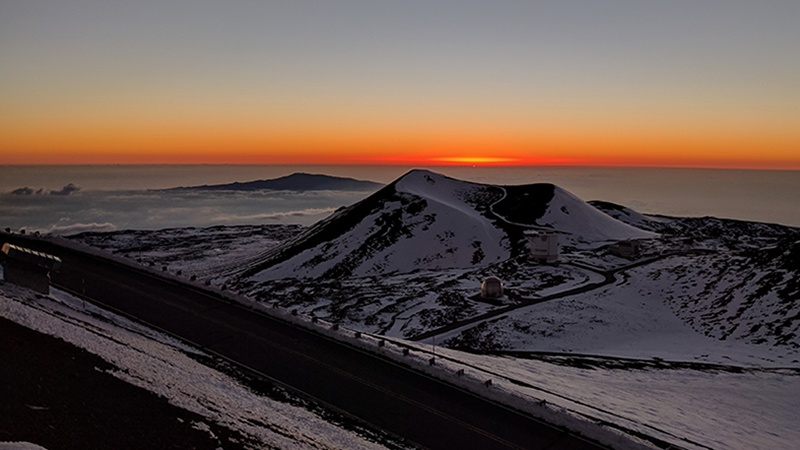
A type of earthquake that rumbles deep below or near dormant volcanoes probably is not suggestive of potentially new eruptions, says a University of Oregon earth scientist.
In a study published May 15 in the journal Science, the UO’s Amanda Thomas and two U.S. Geological Survey colleagues argue that a transformation process of “second boiling” of magma may explain deep, long-period earthquakes. Such quakes, the team concludes, “may more commonly be indicative of stagnant, cooling magma.”
The findings emerged from the team’s identification and analysis of more than a million deep, long-period earthquakes, which ranged in magnitude from 1.2 to 1.5, over 19 years below Hawaii’s Mauna Kea volcano. The quakes occurred some 25 kilometers, about 15 miles, below sea level under the volcano, which last erupted about 4,500 years ago. They occurred on average every 10 minutes during the explored time period.
The prevailing wisdom is that this enigmatic type of earthquake represents magma motion in the subsurface, and sometimes such events are used to forecast eruptions,” said Thomas, an assistant professor in the Department of Earth Sciences. “We found over a million of these earthquakes beneath a dormant volcano that will not, in all likelihood, erupt again.”
Instead of indicating moving magma, the activity is caused by exsolution, a process in which the repeated pressurization of volatiles separates cooling magma into new forms of crystalline minerals. The study is the first to link this process to deep, long-period earthquakes, which occur without the high-frequency energy of normal earthquakes, the researchers noted.
“It’s unlikely that these quakes at Mauna Kea represent magma movement,” Thomas said. “Our interpretation is that they probably, here and elsewhere, represent cooling magma.”
That “everywhere,” she noted, includes the Cascade Range in Oregon and Washington. According to previously published research, 60 locations of deep, long-period earthquakes have been identified beneath six volcanoes in Oregon and Washington: Mount Baker, Glacier Peak, Mount Rainier, Three Sisters and Crater Lake. Mount Baker has recorded the most.
A group of these types of earthquake is also located under Oakridge, which, she said, she plans to eventually explore to see if the same process is occurring.
For Mauna Kea, the researchers wrote: “We propose that a continuous flux of volatiles exsolved from second boiling migrates upward through a matrix of fractures to repeatedly pressurize a complex reservoir system and generate (deep long-period earthquake) seismicity.”
To reach their conclusions, the researchers examined data on seismic waves using envelope cross-correlation, a data-mining technique that identifies more small earthquakes than is possible with algorithms used in traditional seismic monitoring, which often miss such low-energy events. They detected patterns of activity on time scales spanning minutes to years.
Aaron G. Wech of the USGS Alaska Volcano Observatory led the study. Weston A. Thelen of the USGS Cascades Volcano Observatory also was a co-author. The USGS Volcano Science Center and National Science Foundation (grant No. 1848302) supported the project.


Oregon Sen. Merkley warns of “major danger for our Republic” as he accuses President Trump of seeking to block states from certifying election results after DOJ targets Alaska Senate race
Oregon – Sen. Jeff Merkley is warning that President Donald Trump could seek to prevent states from certifying election results...


Oregon Republican gubernatorial candidate Drazan takes aim at Gov. Kotek over $96,000 ODOT hiring contract, tells her to leave the hiring to her in January
Oregon – Oregon Republican gubernatorial candidate Christine Drazan is criticizing Gov. Tina Kotek over the state’s decision to spend $96,000...
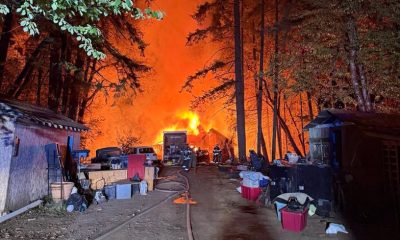

Eugene firefighters battle four-hour blaze that engulfed large rural home as difficult access and lack of fire hydrants complicate response
Eugene, OR – Eugene Springfield Fire crews spent approximately four hours battling a fire that engulfed a large, two-story home...


Eugene Springfield Fire responds to hazardous materials incident after chemical reaction overheats industrial equipment and releases gases
Eugene, OR – Eugene Springfield Fire crews responded to a hazardous materials incident at an industrial facility in West Eugene...


Eugene police invite families to free Halloween ‘Candy with a Cop’ event featuring trick-or-treating, police vehicles and first responders
Eugene, OR – The Eugene Police Department is inviting families to a free Halloween event on Sunday, Oct. 25, where...


33-year-old man arrested after ramming vehicles, punching officer in the face and slashing another with a knife
Eugene, OR – Eugene police arrested a 33-year-old man early Friday after he allegedly rammed parked vehicles, punched an officer...


Oregon Sen. Wyden warns over Trump administration plan for migrant children, says HHS lawyers could represent kids facing deportation while working for the same government seeking to remove them
Oregon – Oregon Sen. Wyden urges Trump administration to reverse plan for HHS attorneys to represent unaccompanied migrant children, warning...


Gov. Kotek warns Oregonians their ballots could be delayed this November as she urges them to make sure their signatures are correct before mailing them
Oregon – Oregon Gov. Tina Kotek is urging voters to make sure their mail-in ballots are signed clearly before returning...
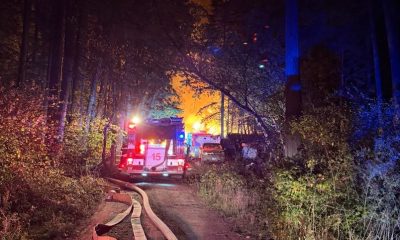

Large rural home destroyed in overnight fire near Eugene as firefighters battle flames for four hours
Eugene, OR – A large, two-story home was fully engulfed in flames when firefighters arrived at a rural property in...


Eugene police investigate theft of elderly woman’s dog after group returns to take border collie while she was sleeping
Eugene, OR – The Eugene Police Department is investigating the theft of a companion animal after a 73-year-old woman reported...


Eugene man arrested on kidnapping warrant after refusing to stop for police and driving toward Walmart entrance during pursuit
Eugene, OR – The Eugene Police Department arrested a man wanted on a felony kidnapping warrant after he allegedly refused...
-

 Eugene6 days ago
Oregon Sen. Merkley warns “we can’t sleepwalk into a decision this consequential” as Senate gets chance to act “before it’s too late” over Trump’s Saudi nuclear deal that could trigger arms race
-

 Oregon6 days ago
“No company should be able to target you using your personal data,” Oregon Sen. Wyden urges Congress to pass his bill banning surveillance ads and targeted advertising by chatbots
-
Eugene3 days ago
Gov. Kotek warns Oregonians their ballots could be delayed this November as she urges them to make sure their signatures are correct before mailing them
-
 Eugene6 days ago
44-year-old man arrested after allegedly striking contractor in the head with skateboard and attacking another with wooden stick
-

 Eugene6 days ago
Eugene considers new micro village housing rules to expand affordable housing options as City Council schedules public hearing
-
Eugene3 days ago
Large rural home destroyed in overnight fire near Eugene as firefighters battle flames for four hours
-
Eugene3 days ago
Oregon Sen. Wyden warns over Trump administration plan for migrant children, says HHS lawyers could represent kids facing deportation while working for the same government seeking to remove them
-
Eugene3 days ago
Eugene police investigate theft of elderly woman’s dog after group returns to take border collie while she was sleeping