
Eugene
Sen. Merkley responds to Supreme Court ruling, warns “it’s just plain scary” after three justices express support for administration’s position on new USPS restrictions for mail-in ballots
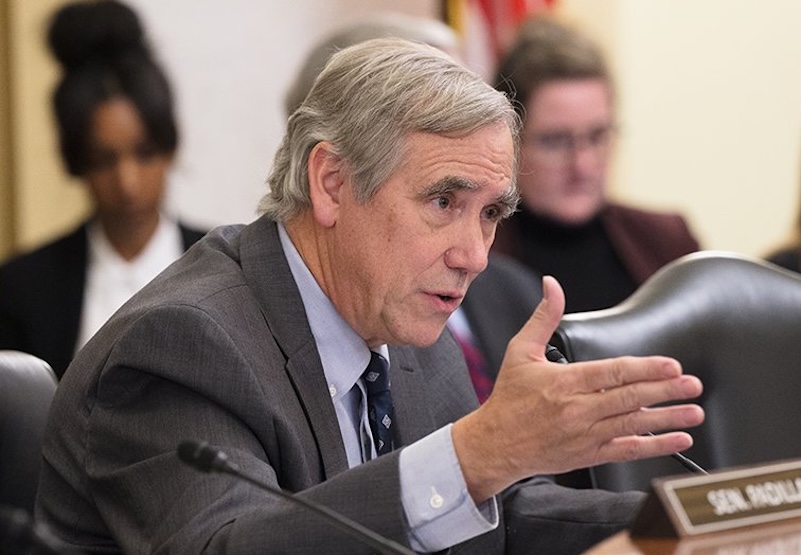
Oregon – “Big news from the Supreme Court. Our work continues to protect vote by mail,” Sen. Jeff Merkley said after the U.S. Supreme Court rejected the Trump administration’s effort to allow new Postal Service requirements for mail-in ballots to take effect before the November midterm elections.
Merkley, an Oregon Democrat and longtime supporter of vote-by-mail, followed the statement with a video in which he celebrated the Supreme Court’s decision but argued that the ruling still raised concerns about the authority of the Postal Service and the federal government over state election procedures.
The Supreme Court on Sept. 14 denied the Trump administration’s request to pause a lower-court injunction blocking new U.S. Postal Service rules governing mail-in ballots. The decision left the restrictions on hold for the 2026 elections. Reuters reported that the rules, developed after President Donald Trump’s March executive order, would have required states to provide voter lists and use USPS-approved ballot envelopes with specific barcode requirements.
The administration had sought to implement the requirements ahead of the November elections, while Oregon and other states challenged the rules in federal court. The states argued that the changes would interfere with their authority to administer elections and could create significant problems for election officials and voters because the rules were being introduced close to Election Day.
A federal judge in Massachusetts had already blocked the USPS requirements, and the Supreme Court’s Sept. 14 order left that injunction in place. CBS News reported that the court rejected the administration’s request to move forward with the new regulations as states prepared to send mail ballots for the midterms.
The Supreme Court’s order was not a complete ruling on every underlying question raised by the case. Justice Brett Kavanaugh, who joined the decision to deny the government’s request, wrote separately that he believed there was at least a “fair prospect” that the Postal Service’s rule fell within its statutory authority. However, he agreed that applying the rule to the 2026 elections would violate the Administrative Procedure Act because state and local election officials did not have enough time to implement the changes.
Justices Samuel Alito and Clarence Thomas dissented from the court’s decision.
Merkley focused heavily on that distinction in his video, saying the ruling was a victory but arguing that the fact that three justices did not fully reject the administration’s position on the Postal Service’s authority was concerning.
He pointed to Article I, Section 4 of the Constitution, which addresses the authority of states and Congress over the times, places and manner of congressional elections. Merkley argued that the constitutional language makes clear that states have a central role in administering elections and questioned why the Postal Service should be able to establish requirements affecting how states conduct vote-by-mail elections.
Merkley also characterized the court’s decision as a rejection of what he called Trump’s “scheme to restrict vote by mail.” He argued that voting by mail is a secure system used by voters in both Republican- and Democratic-leaning states and said he would continue working to protect it.
His comments echo arguments Merkley and other members of Congress made before the Supreme Court. On Sept. 14, Merkley, Sen. Ron Wyden and a bipartisan group of 261 current and former members of Congress filed a brief urging the court to block the USPS rule. They argued that the Trump administration did not have unilateral authority to change the rules governing elections and warned that the new requirements could create confusion for voters and election officials.
The legal fight over mail voting has been particularly significant in Oregon, where voters have used a vote-by-mail system for decades. Oregon Attorney General Dan Rayfield and a coalition of states challenged the USPS rule, arguing that the Postal Service could not decide whether states could use their existing mail-ballot procedures. After the Supreme Court ruling, Rayfield called the decision a victory for Oregon voters and said the state would continue using its existing vote-by-mail system.
The dispute also comes as Oregon officials are dealing with separate concerns involving mail delivery and ballot postmarks ahead of the midterms. Secretary of State Tobias Read has urged voters to use official ballot drop boxes and has sought additional funding for more drop boxes and statewide ballot tracking.
For Merkley, the Supreme Court ruling therefore represents only part of the larger fight over mail-in voting. In the video, he said the decision was a win but warned that he expects continued attempts by Trump and his administration to change the way mail ballots are handled.
Merkley ended his message by saying that his efforts to protect election integrity and vote-by-mail would continue, arguing that the Supreme Court’s decision should not be viewed as the end of the dispute over federal involvement in state election procedures.

Oregon gubernatorial candidate Drazan accuses Gov. Kotek of making homelessness “chronic and permanent” as governor says crisis “wasn’t created overnight and won’t be solved overnight”
Oregon – “Homelessness must be rare and temporary but under Tina Kotek’s failed leadership it’s chronic and permanent.” Oregon Republican...

Oregon Sen. Merkley says getting anything done in the Senate is like “wading through tar” as he joins Montana Republican Sen. Daines in proposing sweeping rules overhaul
Oregon – “Trying to get anything done in the Senate feels like wading through tar.” Oregon Sen. Jeff Merkley made...

Oregon Sen. Wyden takes aim at President Trump over diesel deal, says “he’s rewarding Putin with a windfall agreement that won’t even lower prices”
Oregon – Oregon Sen. Ron Wyden criticized President Donald Trump’s agreement with Russian President Vladimir Putin to supply diesel to...


Large fire involving palletized wood shavings breaks out at Coastal Farm & Ranch in Eugene, prompting early morning response from ESF
Eugene, OR – Eugene Springfield Fire (ESF) crews responded to a reported structure fire at Coastal Farm & Ranch in...


ESF crews work overnight to contain mill fire on Milliron Road as scene expected to remain active for days
Eugene, OR – Eugene Springfield Fire (ESF) crews worked overnight and into the morning as part of a countywide mutual...


Eugene woman arrested for DUII after allegedly speeding, swerving and refusing to exit vehicle, police say her blood alcohol level was .25%
Eugene, OR – The Eugene Police Department arrested a 33-year-old woman after an officer reportedly witnessed her speeding and swerving...

Oregon Sen. Jeff Merkley speaks out after Democrats block Republican stock trading bill, says ‘the bill Republicans are pushing is a sham’
Oregon – Sen. Jeff Merkley is calling for a complete ban on stock trading by members of Congress after the...

Senate candidate Drazan takes aim at Democrat opponent, says Gov. Kotek should ‘spend less time obsessing over Trump’ and more time fixing Oregon after heated debate
Oregon – Oregon state Sen. Christine Drazan is escalating her criticism of Gov. Tina Kotek, saying the Democratic governor should...

Elderly woman arrested for DUII after rear-ending vehicle, nearly crashing into victim again with little child in car before refusing to take a breath test
Eugene, OR – A 61-year-old Eugene grandmother was arrested for DUII Thursday evening after a crash and after police said...
Eugene man arrested after allegedly pistol-whipping unhoused man in the head, attacking another victim and leaving firearm in dumpster downtown
Eugene, OR – Eugene police arrested a 22-year-old man after he reportedly pistol-whipped an unhoused community member and was involved...
22-year-old woman arrested for DUII after driving over sidewalk, handing officer credit card instead of license and refusing to get into patrol car
Eugene, OR – A 22-year-old Eugene woman was arrested for DUII early Saturday morning after an officer reported seeing her...
-
Eugene1 week ago
Senate candidate Drazan takes aim at Democrat opponent, says Gov. Kotek should ‘spend less time obsessing over Trump’ and more time fixing Oregon after heated debate
-
Eugene1 week ago
Oregon Sen. Jeff Merkley speaks out after Democrats block Republican stock trading bill, says ‘the bill Republicans are pushing is a sham’
-
Eugene1 week ago
Elderly woman arrested for DUII after rear-ending vehicle, nearly crashing into victim again with little child in car before refusing to take a breath test
-
Eugene2 days ago
Oregon gubernatorial candidate Drazan accuses Gov. Kotek of making homelessness “chronic and permanent” as governor says crisis “wasn’t created overnight and won’t be solved overnight”
-
Eugene2 days ago
Oregon Sen. Merkley says getting anything done in the Senate is like “wading through tar” as he joins Montana Republican Sen. Daines in proposing sweeping rules overhaul
-
Eugene2 days ago
Large fire involving palletized wood shavings breaks out at Coastal Farm & Ranch in Eugene, prompting early morning response from ESF
-
Eugene1 week ago
Eugene man arrested after allegedly pistol-whipping unhoused man in the head, attacking another victim and leaving firearm in dumpster downtown
-
Eugene1 week ago
22-year-old woman arrested for DUII after driving over sidewalk, handing officer credit card instead of license and refusing to get into patrol car